Contact Us
Thermal Conductive Interface Material --- Make the Heat Conduct Faster
When discussing cooling systems, most people immediately think of fans and heatsink thermal pads. In reality, they often overlook an inconspicuous yet critical heat transfer medium: thermal conductive interface materials.
Thermal conductive interface materials play an indispensable role in thermal management for all types of power devices. Many users assume that the surface of a CPU or the base of a heat sink is perfectly smooth, and therefore no heat transfer medium is required between the two mating surfaces. This assumption is incorrect. Machining processes cannot produce perfectly ideal flat surfaces. Tiny grooves and gaps inevitably remain between a CPU and its paired heat sink, and these voids are filled with air. Air carries a high level of thermal resistance. Without alternative filler materials to lower this thermal resistance, the heat sink’s performance will suffer significantly, and in severe cases, the heat sink may fail to operate properly. This is exactly why thermal media are developed and adopted. Their core purpose is to fill micro and macro gaps between processors and heat sinks, expanding the actual contact area between heat sources and heat sinks.
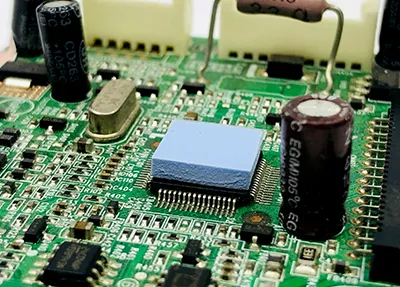
Thermal conductive pads are one category of such heat transfer media. Their primary function is to expand the effective contact area between the CPU and heat sink to facilitate efficient heat transfer.