
Contact Us
The Unseen Bond: How Adhesive Technologies Are Holding the Future of Automotive Displays Together
The rapid evolution of the automotive industry toward software-defined vehicles and intelligent cockpits has transformed in-car displays from simple information panels into the central hub of human-machine interaction. As screens grow larger, curve across dashboards, and integrate multiple functions, the materials that bond, protect, and enhance these displays have become just as critical as the displays themselves. Advanced adhesive products, once overlooked as simple joining materials, have emerged as the silent enablers of automotive display performance, durability, and optical excellence.
The Performance Challenge in Modern Automotive Displays
In the demanding environment of a vehicle, displays face a unique combination of stresses that consumer electronics never encounter. Temperature extremes ranging from sub-zero winters to scorching summer interiors cause materials to expand and contract at different rates. Prolonged exposure to direct sunlight demands resistance to UV degradation and anti-glare properties. Constant vibration from the vehicle's operation tests the structural integrity of every bonded interface. Furthermore, the trend toward curved, bezel-less, and multi-display systems spanning the entire dashboard creates complex geometrical challenges that traditional mechanical fastening cannot solve.
These conditions create critical requirements for adhesive systems: they must maintain optical clarity without yellowing over a decade of use; they must provide structural strength to hold assemblies together through thermal cycling and vibration; they must offer precise, void-free bonding for touch sensitivity; and they must do all this while being invisible to the end-user, preserving the seamless aesthetic of modern vehicle interiors.
How Advanced Adhesives Meet These Demands
Modern adhesive technologies—including optically clear adhesives (OCAs), liquid optically clear adhesives (LOCAs), and structural bonding films—are engineered with a combination of properties that directly address the vulnerabilities in automotive display applications :
①Optical Transparency and Clarity : High-performance adhesives are formulated with refractive indices precisely matching the display stack's glass and polarizer layers. This eliminates internal reflections and light loss, ensuring that the display delivers maximum brightness, true color reproduction, and the high contrast required for readability in direct sunlight.
②Exceptional Adhesion to Dissimilar Materials : Automotive displays are assemblies of diverse materials—glass, plastics, metals, and coatings. Advanced adhesives provide robust bonding between these dissimilar surfaces, accommodating their different coefficients of thermal expansion. This prevents delamination, bubble formation, or touch sensor failure as the vehicle interior heats and cools through countless cycles over its lifetime .
③Durability Under Environmental Stress : Formulated to withstand extreme conditions, these adhesives maintain their mechanical and optical properties across a temperature range from -40°C to over 100°C. They resist humidity, UV exposure, and the chemical attacks from common automotive cleaners and interior off-gassing, ensuring that the display remains pristine and functional for the vehicle's entire service life.
④Impact Resistance and Vibration Damping : Unlike rigid mechanical fixtures, adhesive layers possess inherent flexibility that absorbs shock and dampens vibration. This protects sensitive display components from the constant micro-vibrations of driving and from larger impacts, such as door slams or rough road conditions, contributing significantly to long-term reliability.
⑤Conformal Bonding for Curved Surfaces : With the industry shift toward curved and 3D-shaped displays that wrap around driver and passenger sightlines, liquid optically clear adhesives (LOCAs) and specialized films can conform perfectly to complex geometries. They fill gaps uniformly, enabling the seamless lamination of curved cover glass to curved display modules without optical distortion or air gaps.
Key Applications in Automotive Display Systems
The properties of advanced adhesives make them indispensable for several critical functions in modern vehicle interiors:
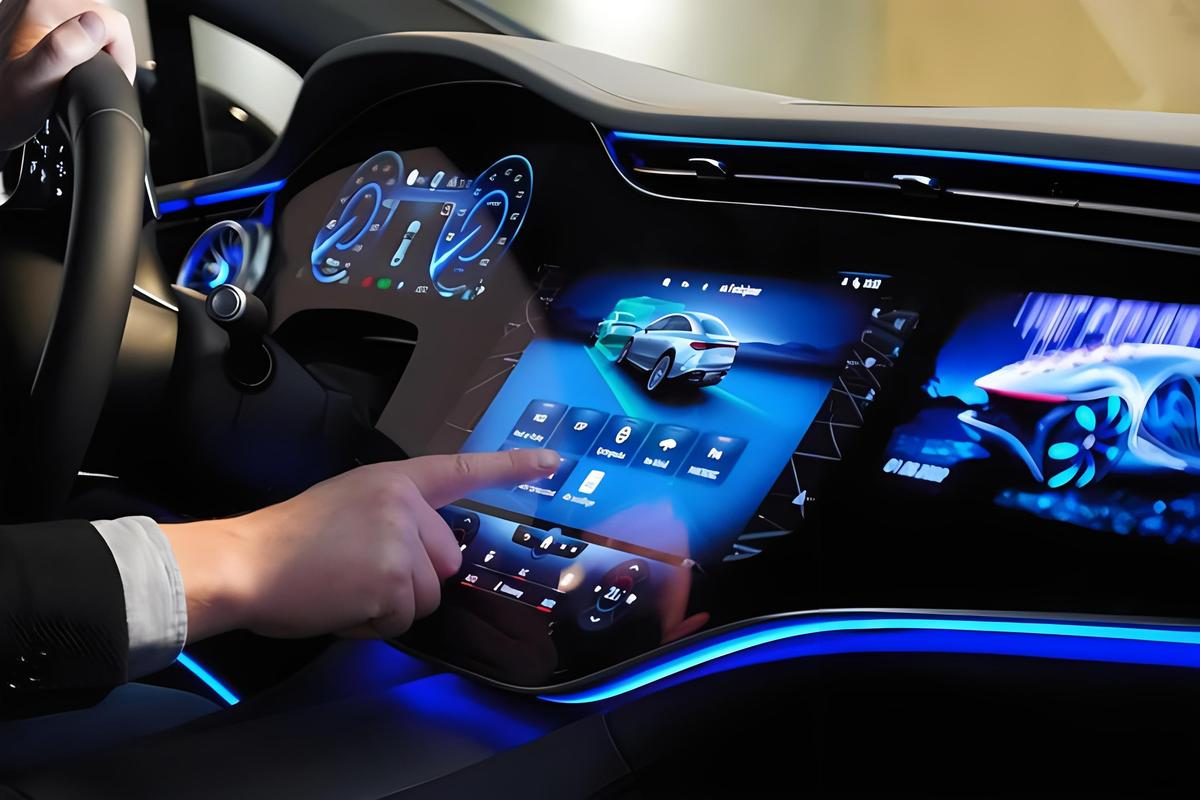
①Touch Panel Lamination : The most visible application is the bonding of the cover lens (often curved glass or polycarbonate) to the touch sensor and display module. Optically clear adhesives create a single, solid optical unit that eliminates the air gap found in older displays. This "optical bonding" dramatically improves sunlight readability by reducing reflections, enhances touch sensitivity by bringing the sensor closer to the finger, and prevents condensation or dust ingress between layers.
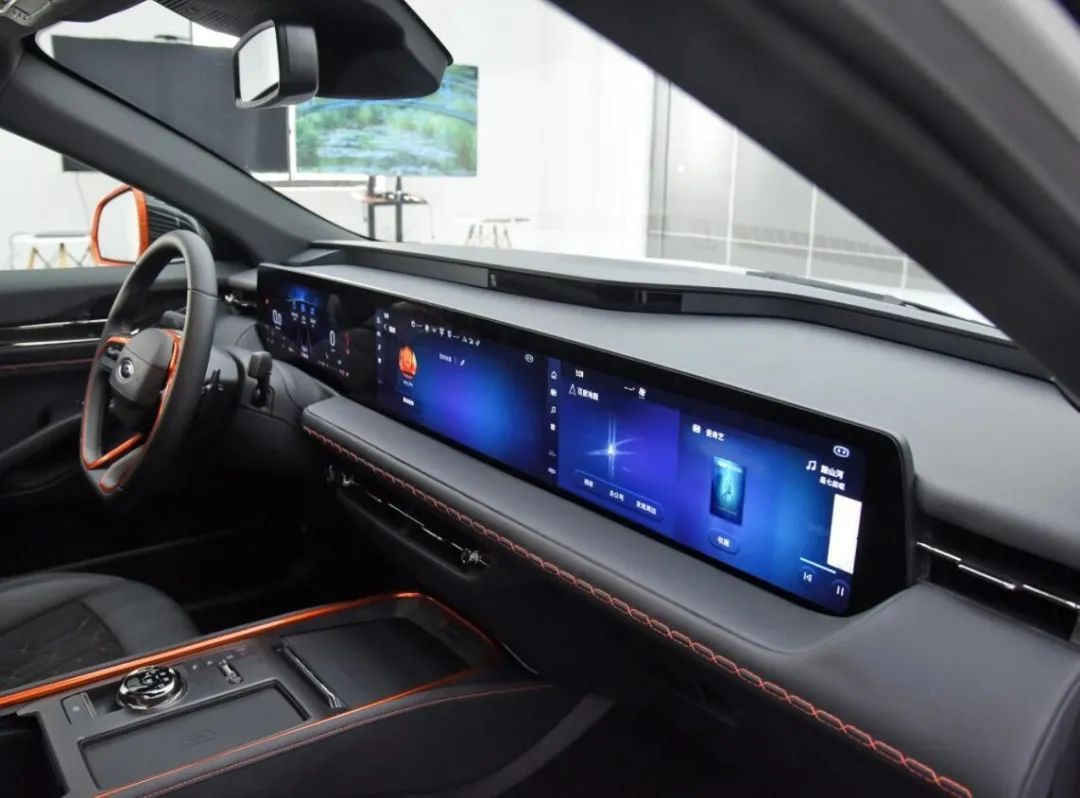
②Curved and Free-Form Display Assembly : As automotive designers create immersive "digital cockpits" with displays that curve, flow, and integrate with the dashboard trim, adhesives provide the only practical method for assembling these complex shapes. They bond the flexible display layers to their curved backlight units or support structures, enabling the dramatic, sculptural designs that define modern luxury vehicle interiors.
③Head-Up Display (HUD) and Combiner Bonding : In advanced head-up display systems, adhesives are used to bond the optical combiner elements or to laminate the films that create the virtual image. The optical precision required for these systems demands adhesives with exceptional clarity and minimal haze to ensure the projected information appears crisp and ghost-free against the outside world.
④Structural Bonding of Display Modules : Beyond optical functions, adhesives provide the primary structural attachment of the complete display module to the instrument panel or center console. Pressure-sensitive adhesives (PSAs) and structural bonding tapes secure the heavy electronic assembly in place, replacing screws or clips that would add weight, require space, and compromise the sleek, minimalist aesthetic.
⑥Conformal Coating for Circuit Protection : Within the display assembly, conformal coatings—liquid adhesive-like materials applied to printed circuit boards—protect sensitive driver electronics from moisture, vibration, and contaminants. This protection is essential for the long-term reliability of the electronics that power the display's millions of pixels.
Conclusion
In the race to create safer, more engaging, and more beautiful vehicle interiors, the quality of what cannot be seen matters as much as what can. Advanced adhesive technologies provide the proven, reliable solutions that directly enable the optical performance, structural integrity, and long-term durability of today's most sophisticated automotive displays. By invisibly bonding disparate materials, absorbing environmental stresses, and preserving optical perfection through years of service, these unsheroic materials have become the hidden foundation upon which the future of automotive human-machine interaction is built.