
Contact Us
Stop the Electromagnetic Rain: Your Ultimate Guide to EMI Absorbers
Ever felt like your sensitive electronics are drowning in a downpour of invisible noise? That erratic Bluetooth connection, that flickering screen, that failed EMC test – all could be symptoms of electromagnetic interference (EMI).
But what if you could hand your device a thick, reliable umbrella? That’s exactly what an EMI absorber does.
Let’s walk through what these quiet heroes are, how they work, and how to pick the right one – without drowning in technical deep water.
1. What Exactly Is an EMI Absorber?
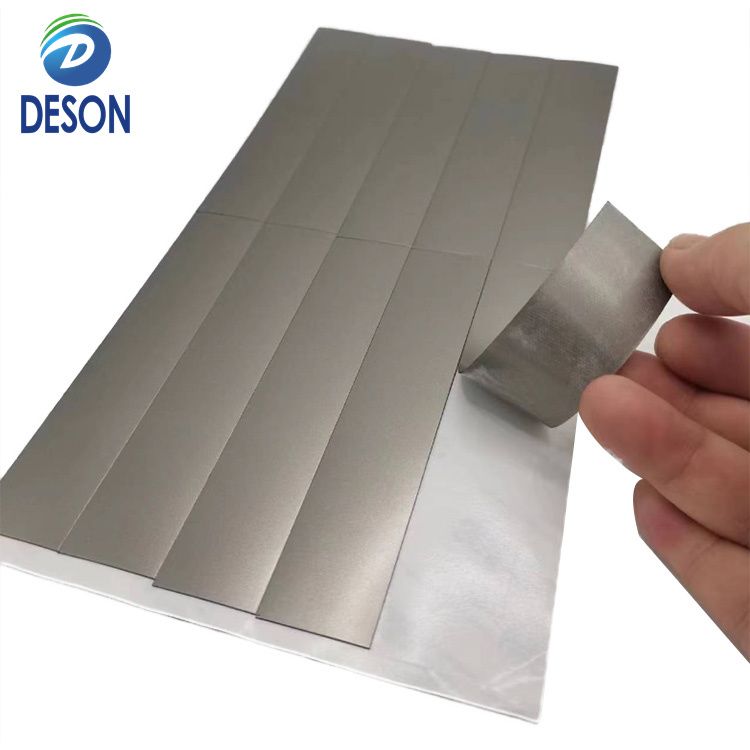
An EMI/RFI absorber is a layered composite of magnetic metals or engineered ferrite materials. It usually comes as a sheet or roll, often with a pressure-sensitive adhesive (PSA) on one side and a protective release liner on the other.
You simply peel, stick, and let it soak up the noise.
Common uses:
Wrapping noisy cables
Sticking onto metal chassis or shields
Protecting chips or antennas (e.g., NFC, wireless charging)
Inserting between stacked PCBs or modules
2. How Does It Work? (No Physics PhD Required)
Imagine your high‑speed digital signals are shouting. The unwanted harmonics – the “splash” – radiate out and interfere with nearby circuits.
An EMI absorber uses high magnetic permeability to attract those stray magnetic fields like a sponge attracts water. Instead of reflecting the noise (like a metal shield), it consumes the energy, converting it into negligible heat.
The result? Cleaner waveforms, lower crosstalk, and a quieter electromagnetic environment.
3. Material Choices – Not All Absorbers Are Equal
The right material depends on the noise frequency, field strength, and your substrate.
| Material | Characteristics | Best for |
|---|---|---|
| Polymer / ferrite composite (soft magnetic) | Flexible, thin, high permeability | Broadband noise from 10 MHz to several GHz |
| Magnetic powder in rubber | Highly conformable | Curved surfaces, gasket‑like applications |
| Ferrite elastomer | Rigid yet flexible sheets | Near‑field absorption, RFID / NFC tuning |
| Conductive foils (Al, Cu, stainless steel) | Reflective, not absorptive | Low‑frequency shielding + grounding (not pure absorption) |
💡 Soft magnetic absorbers are the go‑to for most engineering teams. They contain ceramics, iron, nickel, or zinc oxides dispersed in a polymer matrix.
4. The Sticky Details – Adhesives & Liners
An absorber is only as good as its bond.
Adhesive type: Almost always a non‑conductive acrylic PSA. It offers high temperature resistance, good flow for rough surfaces, and stable dielectric properties.
Release liner: White or blue PET (polyester) film – easy to peel, dimensionally stable for die‑cutting.
⚠️ Don’t ignore liner choice – a poorly matched liner can cause curling or adhesive transfer, ruining your assembly process.
5. Where to Get Them – Off‑the‑Shelf vs. Custom
Standard shapes & rolls – Available from distributors carrying 3M, Laird, TDK, or Würth Elektronik. Good for prototyping or low volume.
Complex or high‑volume designs – You need an adhesive converter. These specialists:
Laminate multiple layers (absorber + foil + adhesive + liner)
Precision die‑cut to your exact 2D/3D geometry
Provide kiss‑cut rolls for automated pick‑and‑place
Search for “adhesive converter EMI absorber” or “custom die‑cut microwave absorber”.
Ready to Clear the Storm?
EMI absorbers are one of those subtle components – invisible when they work well, impossible to ignore when they fail. Next time you face a radiated emissions issue or a sensitive antenna desense, don’t reach for thicker metal. Reach for a magnetic umbrella.
Want to go deeper? Check out our Learning Center for absorption vs. shielding, material impedance charts, and real‑world case studies.